

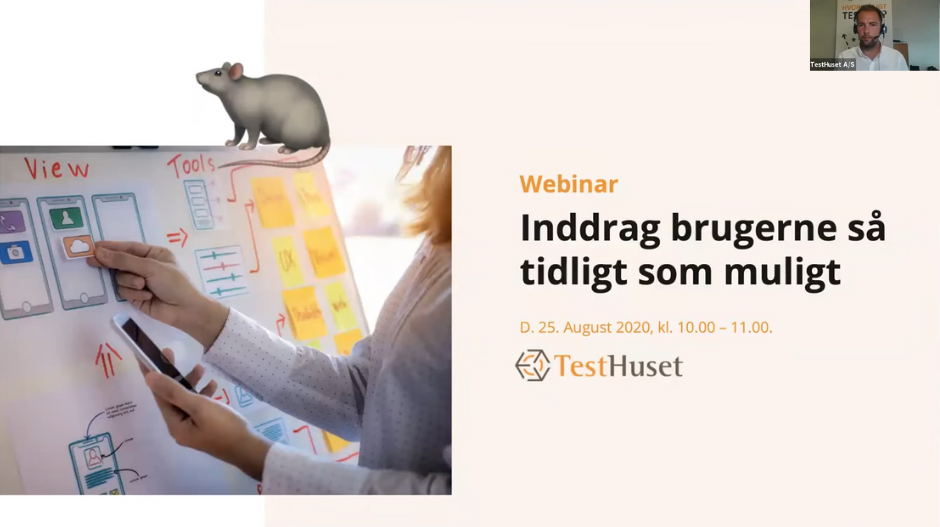
Did you miss our webinar on early user testing with RAT?
More than 150 people have already watched our webinar, User testing as early as possible with RAT, where in just one hour you get an introduction to how the RAT approach (Riskiest Assumption to Test) can be used to test business ideas, digital solutions, or new features—even before a developer has written a single line of code.
RAT (Riskiest Assumption to Test)
The RAT approach is easy to understand and get started with; it enables fast and effective user involvement and makes reporting easy to understand, so both the team and the steering committee can make decisions based on clear, actionable feedback from users.
Three takeaways from the webinar
1. Start early and test with users continuously
- Test as early as possible! It is much cheaper to change and adapt the solution
- early in the process than to spend development time on something users can’t figure out, don’t need, or that doesn’t create value for the business.
- Early in the process, you can for example test:
- Does the concept hold up?
- Is the feature actually in demand by users?
- Is it the right user journey?
- Do users understand the design?
- Just as important is to test and re-test continuously in all phases (idea, design & specification, development, and after launch) and generally as the solution evolves.
2. Drop the gut feelings—start testing
- In most organizations there are people who, with the best intentions, have many opinions and viewpoints about digital products. That is generally positive, as it shows interest in the solution. The challenge arises when decisions are made based on opinions rather than data and feedback from users. Then you risk building solutions that the target group ultimately doesn’t want to use. With RAT, you can instead test these assumptions—both to engage stakeholders and to create a valid foundation for decision-making. In the end, user behavior and feedback should outweigh opinions.
3. Prioritize your RATs based on business goals, user needs, and user journeys
- When is the product a success? And which user need should it solve? This is important to know when starting a project, building a product—and not least when doing user testing. You should therefore start by defining goals for what business success looks like, and which needs you want to solve for the user. Based on these business goals, you can define the most important user journeys.
- User testing and RATs can then be prioritized according to which user journeys are most important for achieving the goals—thereby increasing the likelihood of business success for the product.
High satisfaction with the webinar!
Participants later rated the webinar an impressive 4.4 out of 5 stars and shared, among other things, the comments below:
“I work in an organization where it’s often politically decided which projects we take on, so I was a bit unsure whether the methods in the webinar could be applied—and where UX (in my opinion) often comes into the process later than it should. But after the webinar I’m much more positive that it’s also something we can include when we design, as it sounds both easy and not very time-consuming.”
“It was nice with a new ‘take’ on testing. You could tell it’s a topic that really engages and interests people from all the many questions along the way.”
“Easy-to-understand introduction to a directly applicable tool, illustrated with examples of use and best practice.”
Watch the webinar – User testing as early as possible with RAT

3 tips to get started with RAT
Start small!
RAT is an approach that makes it easy and manageable to get started with user testing. Begin by testing RATs using, for example, remote tools or A/B split testing, as these methods are typically less resource-intensive.
Involve stakeholders in the organization and the development team.
Developers, designers, testers, and business representatives all have different perspectives that can add value when defining RATs and hypotheses for testing. It can also be a good idea to involve project sponsors so their potential opinions are represented in the user testing.
Take a course!
If you want to learn even more about how to involve users in practice, how to ensure you build the right product, and not least how to implement RAT, then a user testing course may be the right path. See for example Trifork QI’s course – Early User Testing.
Need help and sparring?
If you need sparring or advice on how to move forward with introducing user testing and user involvement in your project—both RAT and other techniques—let’s have a dialogue about the possibilities for your organization. Email us at info@testhuset.dk or call us at +45 44 979 979.
Latest articles & Updates