


Successfully complete the common public sector user test by introducing early and continuous testing.
Many organizations wait until the end of the development process and close to the launch date to conduct user testing—simply to comply with current legislation. This is both risky and the most expensive way to test. Instead, testing should be carried out continuously and as early as possible to minimize the risk of having to make changes to the solution just before launch.
What is the common public sector user test?
On December 1, 2015, the Danish Agency for Digitisation decided that all citizen- and business-oriented digital solutions—including all public, digital, and mandatory self-service solutions—must comply with a number of usability requirements and pass the common public sector user test in order to be made publicly available[1].
The purpose of the user test is to ensure that it is easy and quick for users to complete their tasks digitally. A minimum of six people from the solution’s target group must participate in the test and meet the following three minimum requirements:
- 80% of test participants must be able to complete relevant tasks in the self-service solution.
- 80% of test participants must not experience a critical error.
- Overall user satisfaction must be at least 4 on a scale from 1–5, where 5 is the highest rating.
Test continuously and early
The challenge of conducting user testing on a self-service or other digital solution at the end of the process is that it is far more expensive and time-consuming to make changes at this stage than it is to do so early and continuously during development.
The key to getting off to a strong start and passing the common public sector user test the first time is therefore to test usability continuously and early. The Danish Agency for Digitisation explicitly recommends involving users continuously and early in the development of the solution, and that users test the solution already during the development phase[2].
The Danish Agency for Digitisation recommends involving users continuously and early during the development of the solution.
By testing continuously and early, it becomes easier to adjust the solution based on feedback from end users—without incurring significant additional development costs. Overall, this results in a more cost-effective and higher-quality solution for citizens.
Avoid high costs
User involvement—whether early, continuous, or late in the process—can become costly in terms of time and resources. Trifork QI offers two suggestions on how to involve users faster, more efficiently, and at a lower cost.
One way to involve users early is through the RAT (Riskiest Assumption Test) approach, which helps ensure that you are building the right digital product. Another method we recommend at Trifork QI is using remote tools, such as Preely, to digitalize the testing process.
RAT (Riskiest Assumption Test)
RAT is an approach for validating a product, idea, or assumption before launching and building it. The goal of RAT is to test the project’s most risky assumptions—and thereby avoid potential pitfalls.
The approach prevents spending time and money on features and solutions that few or no users actually need or use.
Join our free webinar: User testing as early as possible with RAT.
Remote tools
Remote tools and tests provide excellent opportunities to gain insight and feedback from users when the budget is limited, the timeline is tight, or it is difficult to recruit participants for testing. In a fast-changing world and with agile IT projects, remote tools are a clear advantage, as they make it easy and quick to involve users and collect continuous feedback. At Trifork QI, we have extensive experience with—and recommend—Preely for this purpose.
Remote tools provide valuable insights and highly productive user feedback—even with limited time and budget.
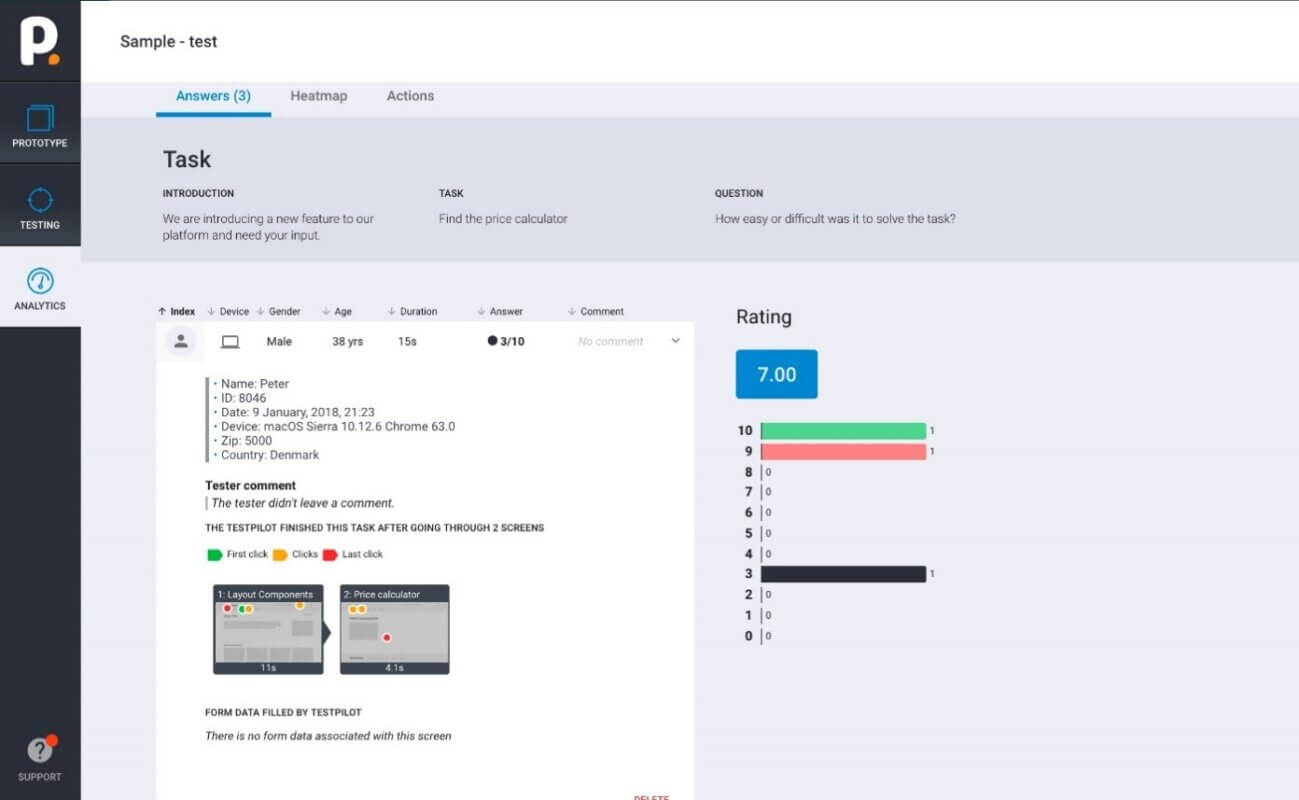
Below is an example of a test result created in Preely.
Contact and questions
If you need help conducting an early testing process to pass the common public sector user test—or to get started with early and continuous testing—please contact us at +45 44 979 979 or via email at info@testhuset.dk.
Latest articles & Updates