

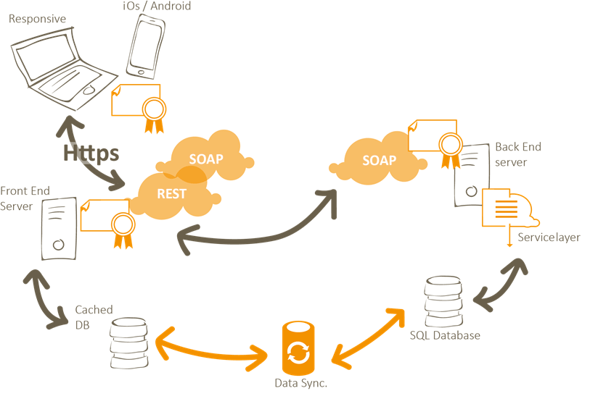
Are you considering getting started with API testing? In this blog post, we provide an introduction to the topic and answer fundamental questions such as what API testing is, why you should perform it, and not least what the biggest challenges are.
What is API Testing?
API is short for Application Programming Interfaces. APIs ensure communication and exchange data between two or more IT systems.
API testing is performed at the most critical layer of the software architecture, namely the business layer. The business layer sits between the user interface / GUI (Graphical User Interface) and the database layer, and it is within this layer that business logic processing and data transactions take place.
In some respects, API testing is quite similar to testing a user interface (GUI), as the focus in both cases can be on evaluating input values and returned data. However, it is important to test at the API level, since this can often be done before the GUI is ready, allowing you to detect and fix critical defects earlier in the process.
API testing has become an increasingly important part of system testing, as more organizations use service-oriented architecture (SOA), where APIs and web services are essential.
Why Should You Perform API Testing?
- Language-independent: Data is exchanged via XML or JSON, so any programming language can be used for automation.
- GUI-independent: API testing can be performed to validate the application’s core functionality, uncover defects, and evaluate build robustness – before the GUI is ready.
- Improved test coverage: API testing enables you to create automated tests with high coverage, including both positive and negative scenarios.
- Reduced testing costs: With API testing, defects can be identified before GUI testing. These defects often become critical during GUI testing, so identifying them early is cost-effective.
- Faster releases: Test cases that take around 10 hours when performing UI regression testing will typically take about 1 hour using API testing. This enables organizations to release builds faster.
What Are the Biggest Challenges in API Testing?
Here are some of the biggest challenges when working with API testing.
- Structuring test cases can be difficult, as a tester may need to manage millions of test cases.
- The tester must have expertise in the programming language(s) in which the API is developed.
- Insufficient documentation from the API developer can make it difficult for a test analyst to understand the purpose of API calls.
- Correct sequencing of calls is required, as incorrect sequencing may lead to insufficient test coverage.
- No GUI: The absence of a graphical interface can make it more challenging for testers to provide input values.
- Exception handling functionality must be thoroughly tested.
Regardless of the challenges you may encounter when performing API testing, it is necessary and crucial to ensure an overall successful and effective test process. If an API fails because defects were not detected early, there is a high risk of disrupting not just a single application, but an entire chain of business processes of which it is a part.

Getting Started with API Testing?
If you are getting started with API testing, you should base your work on a process similar to the one below. Here you will find a generic test process for API testing.
API Test Planning
Plan your API testing like any other test. What needs to be tested, when should it be done, and who is responsible?
Monitoring and Control
Monitor and control the creation and execution of your API tests.
API Test Analysis
Analyze and review the test basis or API requirements. What is the application workflow? What is the purpose and function of the API?
API Test Design
In this step, you design your test cases based on the requirements. You can use test design techniques to ensure the best possible coverage.
API Test Implementation
Implement API test scripts, set up the test environment, and prepare data for testing.
- Implement your API test scripts: Implement API test scripts in tools such as Postman, SoapUI, etc.
- Set up the test environment: The next step is to configure a test environment with the necessary parameters related to the API.
- Use application data: Consider and include realistic application data as test data for API tests to ensure realistic behavior and higher coverage levels.
API Test Execution
Execute your implemented test cases.
API Test Closure
Ensure everything necessary has been tested, that the desired coverage has been achieved, that outstanding defects have been handled, etc. Finally, write a summary report of your API testing.
Would You Like to Learn More About API Testing?
You are welcome to contact us if you have any questions at +45 44 979 979 or via email at info@testhuset.dk
Latest articles & Updates